
Sourcing Museum Display Cabinets from China — What Curators Need to Know About Tempered Glass Vitrines and Factory Pricing | UV Protection
The Problem With Western Museum Cabinet Suppliers
A curator at a national museum told me something last year that stuck: “We spent more on display cabinets than we spent on the artifacts inside them.”
She was not exaggerating. Museum-grade display vitrines from Western brands come with Western price tags. A single sealed glass cabinet can cost more than a used car. Fill a mid-sized exhibition hall with fifteen of them, and you are looking at a number that makes your funding committee flinch.
This does not mean the cabinets are overpriced in a dishonest sense. American, British, and Australian manufacturers pay American, British, and Australian wages. They run factories in high-cost cities. They work through museum consultant networks that add their own margins. The product is good. The price reflects the cost structure.
But if you are curating a museum in a country where the national culture budget is stretched thin—and that describes most of the world—you need to know there is another way. Chinese manufacturers in the Luoyang steel furniture industrial zone have been building tempered glass display cabinets for decades. The materials are the same. The safety certifications are the same. The factory price is one-fifth to one-tenth of what a Western brand charges.
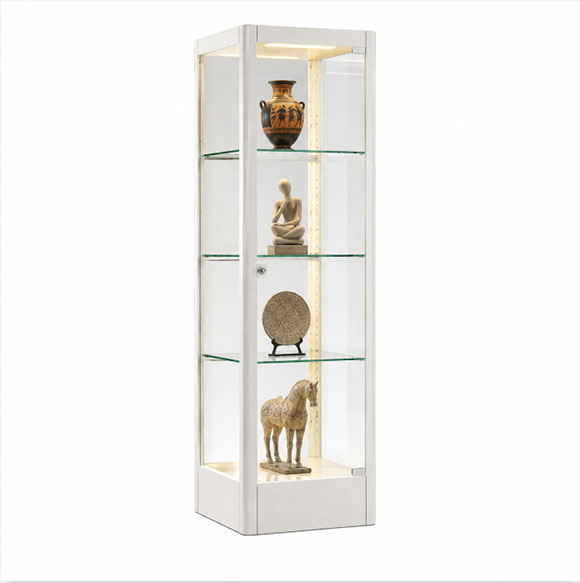
What Actually Makes a Display Cabinet Museum-Ready
Forget the word “museum-grade.” It has no legal definition. Instead, focus on four things that actually matter:
Tempered safety glass, not regular glass. If a visitor leans on a regular glass panel and it breaks, someone gets cut. If a tempered glass panel breaks—which takes significant force—it crumbles into small rounded pieces. Our cabinets use 5mm tempered glass with CCC certification, the Chinese national safety standard. It meets or exceeds the requirements of CE and ANSI equivalent standards.
A sealed structure that slows dust ingress. Dust is the number one destroyer of museum artifacts. It settles into textiles, abrades polished metal, and builds up inside display cases within weeks. A proper cabinet needs tight-fitting doors, sealed frame joints, and no gaps where glass meets metal. We use EPDM rubber gaskets along all glass edges—not silicone caulk that degrades over time, but a durable sealing strip that holds up for years.
A real key lock, not a push latch. Museum visitors include children who touch things and adults who absentmindedly lean. A magnetic push-to-open latch is not security. Our metal key lock is simple, mechanical, and reliable. You turn the key, the deadbolt slides into the steel frame, and the door stays shut until someone with the key opens it.
A frame that does not wobble after five years of daily use. Museum cabinets get opened and closed hundreds of times a week. Cleaners bump them. Visitors press against them. A cold-rolled steel frame with electrostatic powder coating handles daily abuse without sagging, warping, or working loose at the joints.
Why Chinese Factory Pricing Is So Different
The steel costs about the same everywhere. The glass costs about the same everywhere. The difference is what happens after raw materials.
In the Luoyang Pangcun industrial zone, a skilled metalworker earns a fraction of what a metalworker earns in Melbourne or Manchester. The factory does not carry a brand marketing department. There is no museum consultant commission baked into the price. The factory sells to you directly—no distributor, no showroom markup, no educational procurement surcharge.
This is not a story about “cheap Chinese labor.” It is a story about supply chain length. When you buy a museum cabinet from a Western brand, your money passes through: the factory → the brand’s markup → a distributor → a museum consultant → your institution. That is four layers of margin. When you buy directly from us, your money passes through: our factory → you. That is it.
What Size Cabinet Fits Your Exhibition
| Type of Exhibit | Model | Why |
|---|---|---|
| Coins, jewelry, small documents | 1800mm Double Door, 5-tier | Maximum shelf surface for small items |
| Sculptures, pottery, large objects | 2000mm Double Door, 5-tier | Extra interior height for tall displays |
| Center-of-room 360-degree viewing | Full-transparent 4-side glass | Visitors see from every angle |
| Wall placement in narrow gallery | 400mm Single Door, 5-tier | Slim profile, fits tight spaces |
| Textiles, paintings, light-sensitive work | Any double-door + UV film upgrade | Blocks harmful UV wavelengths |
All models use the same 5mm tempered glass, same cold-rolled steel frame, same EPDM gaskets. The choice is about dimensions, not about getting a “better” or “worse” version of the product.
Three Questions Curators Should Ask Any Supplier
“What is the glass thickness and safety certification?” Anyone can say “tempered glass.” Ask for the certification document. Ask for the thickness in millimeters. The right answer is “5mm” and “CCC certified” or equivalent. If they cannot give you a straight answer in ten seconds, they are reselling something they did not make.
“How do you crate glass cabinets for sea freight?” Glass breaks when crating is done wrong. We use reinforced plywood crates with 40mm closed-cell foam padding between every glass surface. Each crate is strapped, labeled with orientation arrows, and loaded into containers by our own shipping team—not handed off to a third-party logistics provider who treats it like any other box.
“Can I order one sample before a bulk order?” The correct answer is yes. Any factory that refuses a sample order is not a factory—it is a trading company that has never seen the product. We ship single-unit samples worldwide. You evaluate the cabinet in your own space, under your own lighting, with your own artifacts inside it. If it works, you order more. If it does not, you learned something for the cost of one cabinet plus freight.
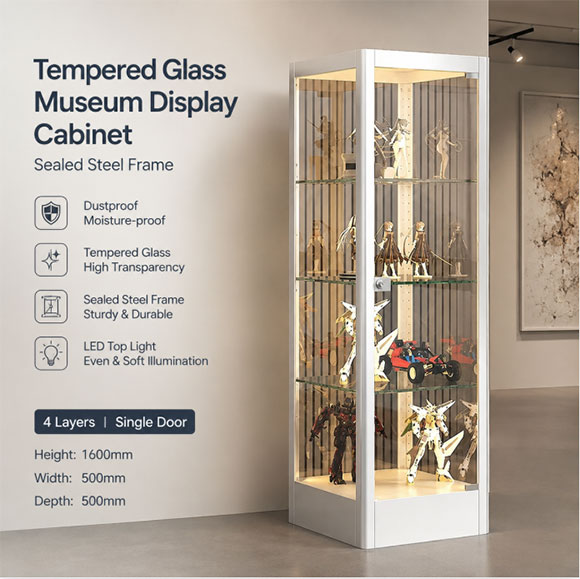
What About Climate Control
A glass display cabinet is not a climate-control chamber. If your museum is in a tropical region and your collection includes materials that need precise humidity control, the room environment matters more than the cabinet.
That said, a sealed cabinet with EPDM gaskets significantly slows moisture exchange. For collections of coins, ceramics, metalwork, fossils, or stone artifacts, this level of protection is usually sufficient. For paper, parchment, textiles, or waterlogged archaeological finds, you need a dedicated climate-controlled vitrine—which is a different product category with a different cost structure.
The right question is not “can this cabinet control humidity.” It is “does my collection need humidity control, or does it just need dust protection and physical security.” Most museum collections need the second one. Make sure you are not paying for the first one when you do not actually need it.
Shipping and Lead Time
Production takes two to four weeks depending on order volume and current factory schedule. Sea freight to most international ports takes three to six weeks. If you need cabinets for an exhibition opening, count backward from the opening date and add a two-week buffer for customs clearance and local transport.
For urgent orders of one to five cabinets, we offer air freight. Transit time is seven to ten days to most destinations. The cost is higher, but when your exhibition opening is six weeks away and you have no display cabinets yet, the math changes.
What to Do Next
If you are planning a museum exhibition, expanding a gallery, or building a university collection hall, contact us with your specifications. Tell us how many cabinets you need, what dimensions fit your space, and what you plan to display inside them. We will give you a quote within two working days, along with production photos of similar cabinets we have built for other institutions.
No consultant markup. No distributor margin. Just the cabinet, built in our factory, shipped to your door.
Also read: Why Steel Cabinets Outlast Wood and Plastic | How to Protect Display Items from Dust
Explore more: Tempered Glass vs Regular Glass for Museum Display | How to Protect Artifacts from Dust and Humidity