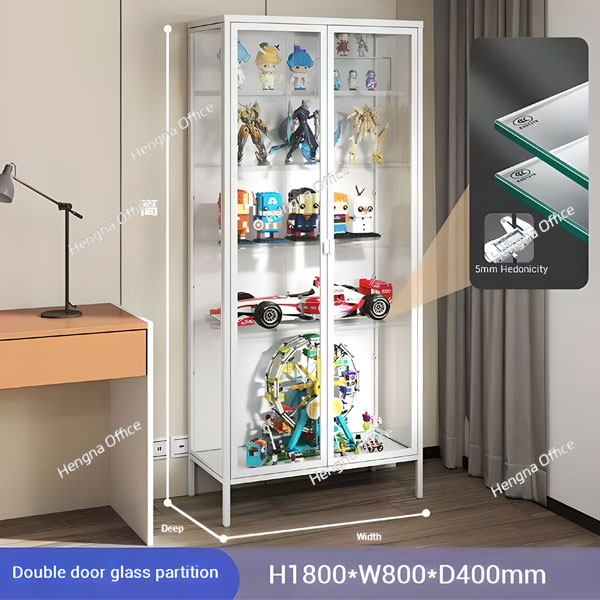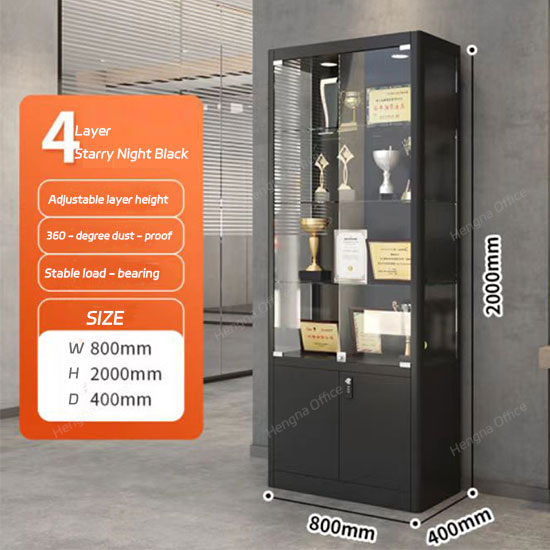
School Trophy Display Cabinet — Lockable Tempered Glass Showcase for K-12 Hallways and University Award Rooms | Shatterproof Design
The Trophy Shelf Problem
Every school has one. That shelf in the main office or the hallway outside the gym, covered in trophies from the last fifteen years. Some are dusty. Some are missing the little figure on top. A few belong to teams that no one remembers. The shelf sags in the middle.
This is not a storage problem. It is a missed opportunity.
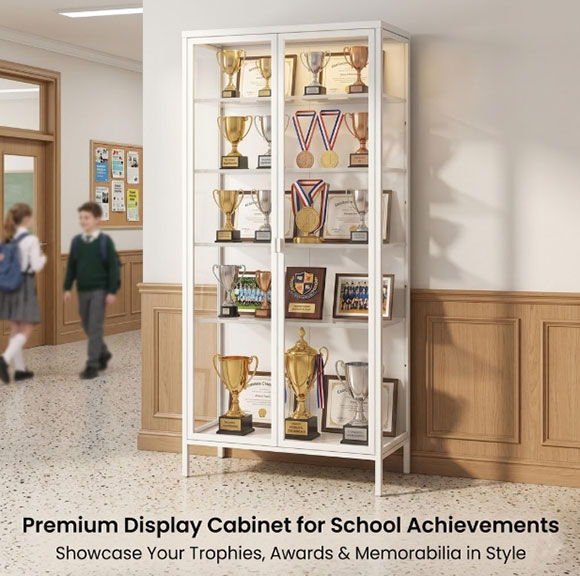
When students walk past a proper glass display cabinet—locked, lit, organized—they stop and look. They see last year’s basketball championship trophy next to the debate team’s first-place plaque. They see names they recognize. And a certain kind of kid thinks: I want my name in there.
That cabinet is not furniture. It is free motivation, working every day, without anyone needing to deliver a speech.
If you are a school administrator, a facilities manager, or a PTA parent who got volunteered to “look into trophy cases,” here is what you need to know before you spend the budget.
What a School Display Cabinet Must Survive
A school is a hostile environment for furniture. Kids run. Balls fly. Chairs get dragged. Doors get slammed. Janitors mop aggressively. Humidity spikes and drops with the seasons. If a cabinet can survive five years in a K-12 hallway, it can survive anywhere.
Four things separate cabinets that make it from cabinets that do not:
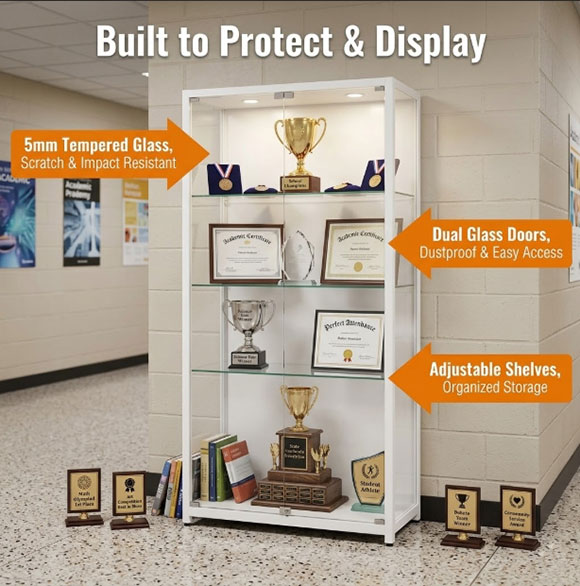
1. Tempered glass only. Regular glass in a school hallway is an accident you can predict. Someone will bump it. A basketball will hit it. A student will lean their full weight against it while tying their shoe. Tempered glass—the kind used in car side windows—breaks into small rounded pebbles when it fails, not dangerous shards. Our cabinets use 5mm tempered glass with CCC safety certification.
2. Steel frame, not wood or particle board. Wooden display cabinets look nice for two years. Then humidity gets in. The doors start sticking. The shelves bow. The lock mechanism loosens because the wood around the screws has expanded and contracted a hundred times. A cold-rolled steel frame with powder coating does none of that. Year six looks the same as day one.
3. A real lock. Trophies disappear. It happens enough that school administrators have a protocol for it. A magnetic push-latch or a glass-door thumb-turn is not a lock. Our metal key lock uses a deadbolt that slides into the steel frame. You cannot pop it open with a credit card or a bent paperclip.
4. Adjustable shelves. A basketball trophy is 45 centimeters tall. A debate medal is 5 centimeters wide. If your shelves are fixed at the factory, you waste half the cabinet’s storage volume. Our glass shelves sit on built-in clips. Move a shelf up or down in ten seconds. No tools. No drilling.
What Size for What School
| Your School | Cabinet | Holds |
|---|---|---|
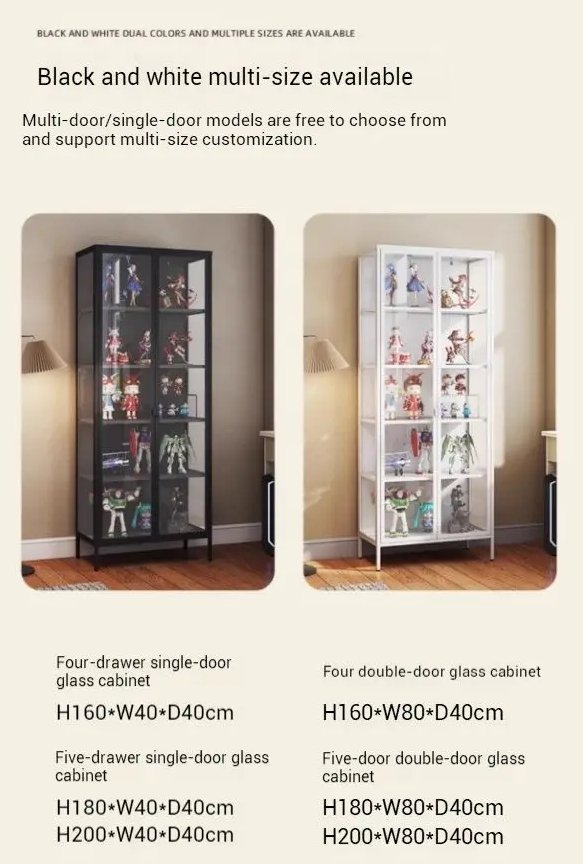
| Small primary, under 500 students | 1600mm Double Door, 4 shelves | 15-25 trophies |
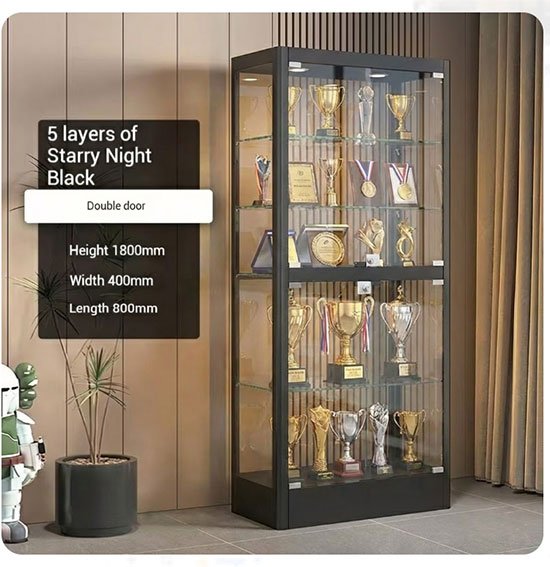
| Medium K-12, 500-1500 students | 1800mm Double Door, 5 shelves | 25-40 trophies |
| Large international school, university | 2000mm Double Door, 5 shelves | 40-60 trophies |
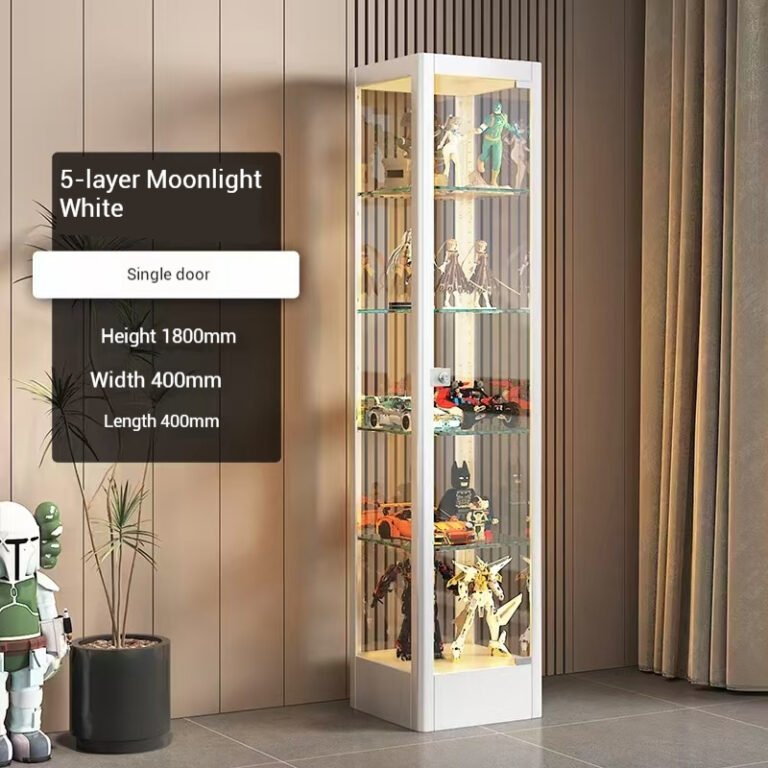
| Narrow corridor, single wall | 400mm Single Door, 5 shelves | 10-15 trophies |
| Center of room, both sides visible | Full-transparent 4-side model | 360-degree display |
Most schools order three to six cabinets. Two large double-door units for team sports, one medium unit for academic awards, and a slim single-door unit for the corridor near the principal’s office. This layout covers a standard school trophy display area for well under what a single cabinet from a Western educational furniture catalog costs.
Why Educational Furniture Catalogs Are So Expensive
A “school trophy case” from a US educational furniture supplier costs a lot. A “school display cabinet” from a UK catalogue costs even more once you convert currency. The materials are the same as what we put in our cabinets—tempered glass, steel frame, key lock.
The extra money pays for: the distributor’s warehouse, the catalog printing, the sales rep who visits your school, the “educational furniture” brand markup, and the assumption that schools spend public money and are less price-sensitive than private buyers.
We do not print catalogs. We do not have sales reps. We manufacture the cabinet in our factory in Luoyang, and you buy it from us directly. The factory cost for an 1800mm double-door school trophy cabinet is a fraction of what a Western catalog charges. Add sea freight to your country’s port, and the landed cost per cabinet is still dramatically lower than buying domestically.
Procurement Timeline for Schools
School budgets follow a rhythm: approved in spring, ordered in early summer, installed before the fall term. If your school year starts in August or September, you need to place the order by April or May to account for production time and ocean freight.
A typical timeline:
April-May: Contact us with specifications. We quote within two working days.
May-June: Place order with 30 percent deposit. Production begins.
June-July: Cabinets are built, crated, and loaded into a container.
July-August: Ocean freight (three to six weeks to most ports). Customs clearance. Local delivery.
August: Cabinets are unwrapped, assembled (they ship flat-packed, which saves about 40 percent on freight), and installed.
For urgent needs—a ribbon-cutting ceremony in six weeks, a donor visit, a new building opening—we can ship up to five cabinets by air freight. Transit time drops to seven to ten days.
Can You Match Our School Colors
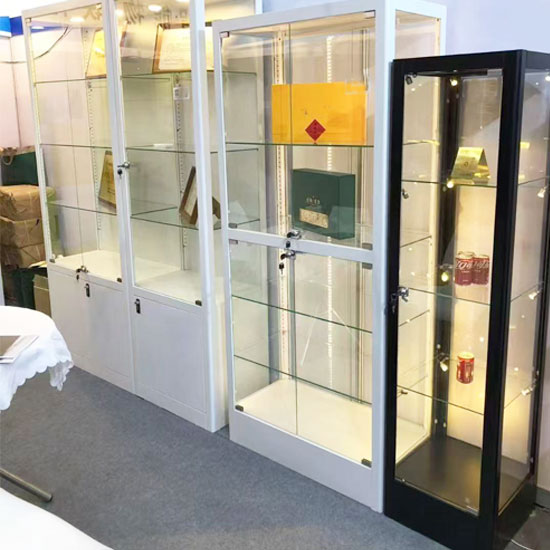
Yes, for orders of ten cabinets or more. Our standard finishes are Starlight Black and Classic White. Custom RAL powder coating is available for bulk orders. Many schools choose their institutional color—navy, forest green, maroon, gold—and we match it at the factory before the cabinets ship.
Custom engraving on the frame (“Donated by the Class of 2025”) is also available on bulk orders. These small touches matter when a donor or alumni group funded the display.
How to Plan Your Trophy Hall Layout
Do not just buy cabinets and figure out placement later. Measure the space first.
Leave at least 90 centimeters of walking space in front of each cabinet. A cabinet door swings open 40 to 50 centimeters. You need room for a person to stand, open the door, and reach inside without backing into a wall.
Place the tallest cabinets against the back wall. Use the slim 400mm single-door units for side walls or alcoves. If the room has a center island, put a full-transparent model there—students can see the trophies from both sides as they walk around it.
Lighting matters more than people think. A trophy cabinet in a dark hallway corner might as well not exist. Natural light from a nearby window is ideal, but if that is not available, a simple LED strip inside the cabinet (adds a small amount to the unit cost) makes the difference between “that dark corner cabinet nobody looks at” and “the first thing visitors see when they walk in.”
Get a quote for your school’s trophy display →
Also read: Why Steel Cabinet Frames Outlast Wood in School Buildings | How Much Force Can Tempered Glass Actually Take