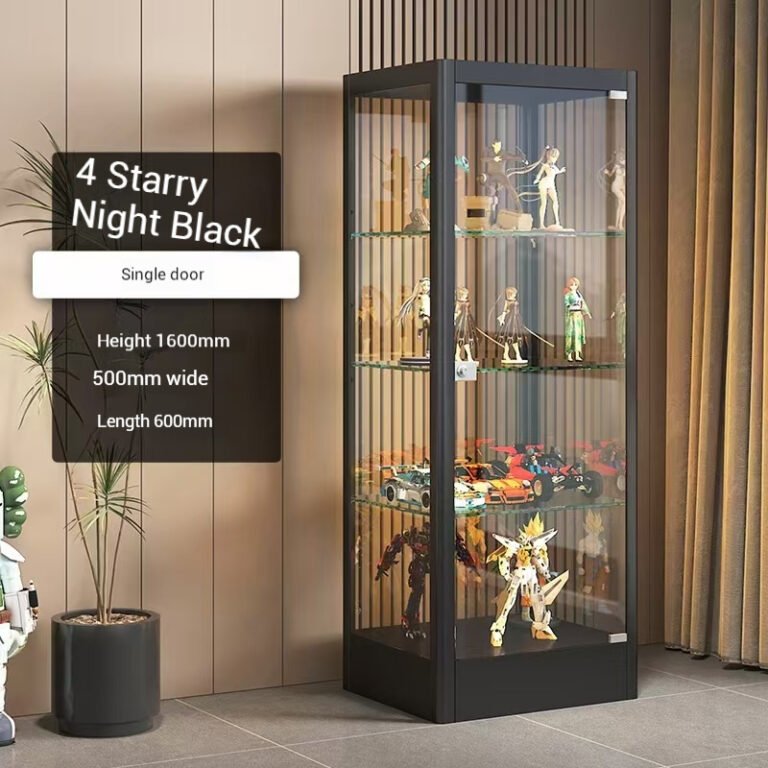
Church Display Cabinet Tempered Glass — Secure Lockable Showcase for Religious Artifacts and Sacred Objects | Heavy-Duty Build
Sacred Objects Need More Than a Shelf
A pastor in Accra showed me his church’s display cabinet. The door did not close. The glass had a crack running from corner to corner. The bottom shelf bowed under the weight of a brass chalice that had been in the parish for eighty years.
“We keep meaning to replace it,” he said. “But where do you buy a proper church display cabinet in Ghana?”
He is not alone. Churches, cathedrals, shrines, mosques, temples—religious communities worldwide hold objects of deep significance. Silver chalices. Hand-carved crucifixes. Embroidered vestments. Illuminated manuscripts. And too often, these objects sit on open shelves, or in wooden cabinets that warped years ago, or behind glass so thin a child could break it by leaning against it.
This is not about decoration. It is about stewardship. If an artifact has survived a hundred years in your community, it deserves a cabinet that will protect it for the next hundred.
If you are a pastor, a parish council member, a diocesan administrator, or a trustee of a religious institution, here is what to look for.
Five Things a Church Display Cabinet Must Get Right
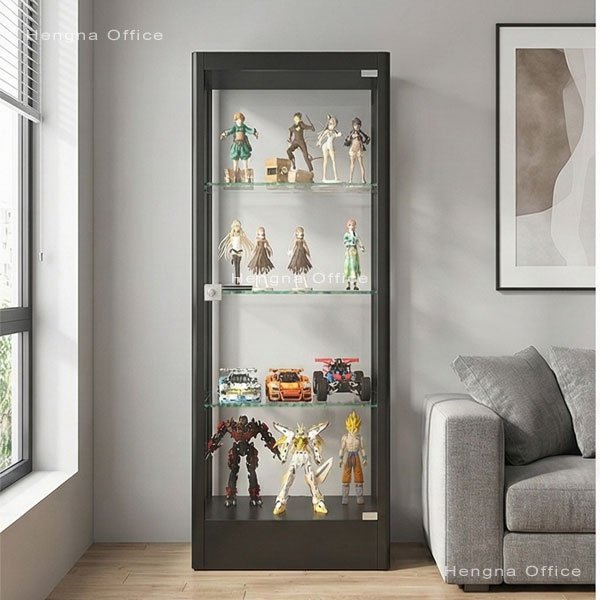
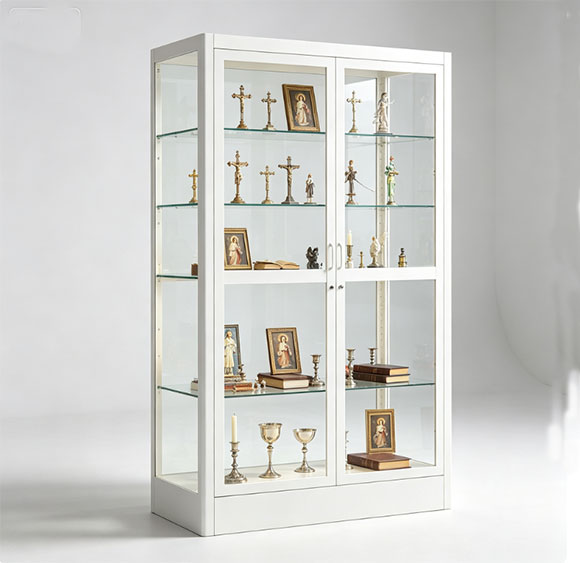
1. It must not draw attention to itself. A retail display case with LED strips, mirrored backing, and a glossy finish looks wrong in a sacred space. The cabinet should be understated. A matte white or black powder-coated steel frame. Clear tempered glass. No branding on the front. The object inside should be the focus—not the box around it.
2. It needs a real lock. Sacred objects get stolen. It happens in wealthy neighborhoods and poor ones, in cathedrals and village chapels. A cabinet that someone can open with a paperclip is not security. Our metal key lock uses a deadbolt. You turn the key, the bolt drives into the steel frame. The door does not open until someone with the key turns it back.
3. The materials must be inert. Some wooden cabinets use glues and finishes that release chemicals into the air over years. Those chemicals tarnish silver. They damage old textiles. A powder-coated steel frame and tempered glass do not off-gas. They are chemically stable. What you put in the cabinet today reacts with the same materials in twenty years.
4. It needs to sit level on an uneven floor. Churches built decades or centuries ago rarely have flat floors. A display cabinet with fixed feet wobbles. A wobbling cabinet looks cheap and risks tipping. Our cabinets have adjustable leveling feet on all four corners. Turn them by hand until the cabinet sits solid.
5. The glass must be tempered, not regular. If a glass panel in a church breaks, someone is standing right there when it does. A parishioner, a child, a visitor. Regular glass breaks into sharp shards. Tempered glass—the same type used in car windows—crumbles into small rounded pieces when it fails. In a place where families gather, this is not a preference. It is a safety requirement.
Which Cabinet for Which Church Space
| Location | Size | What It Holds |
|---|---|---|
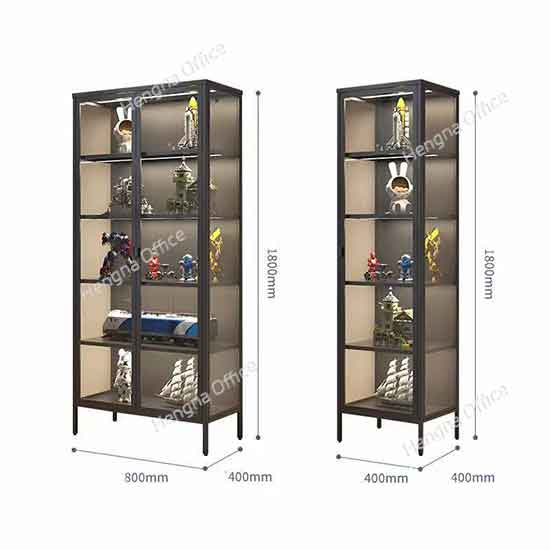
| Narthex or entrance area | 1800mm Double Door, 5 shelves | Historical parish display, welcome materials, community timeline |
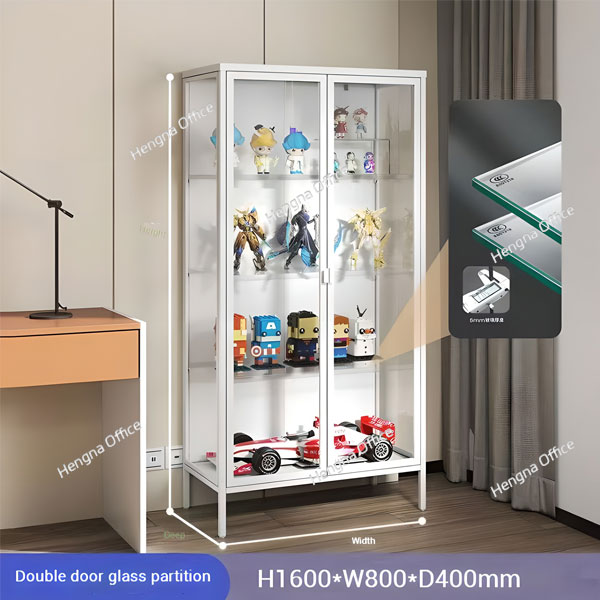
| Side chapel or shrine | 1600mm Double Door, 4 shelves | Relics, icons, devotional objects, votive offerings |
| Sacristy or vestry | 2000mm Double Door, 5 shelves | Liturgical vessels, vestments, sacramentals, ceremonial objects |
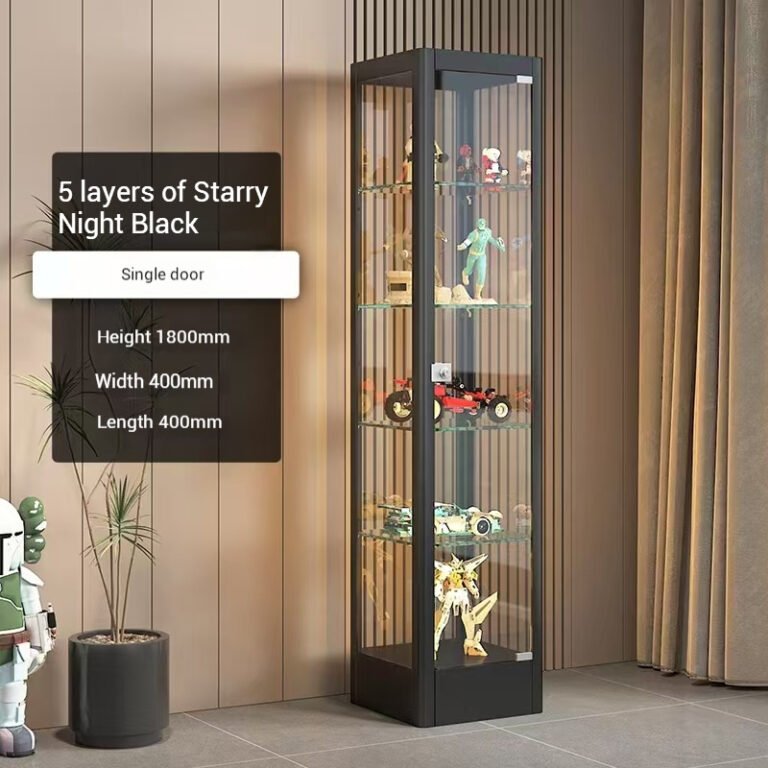
| Narrow corridor or alcove | 400mm Single Door, 5 shelves | Single prominent artifact or framed document |
| Parish hall or community room | Full-transparent 4-side model | Rotating exhibits, anniversary displays, history projects |
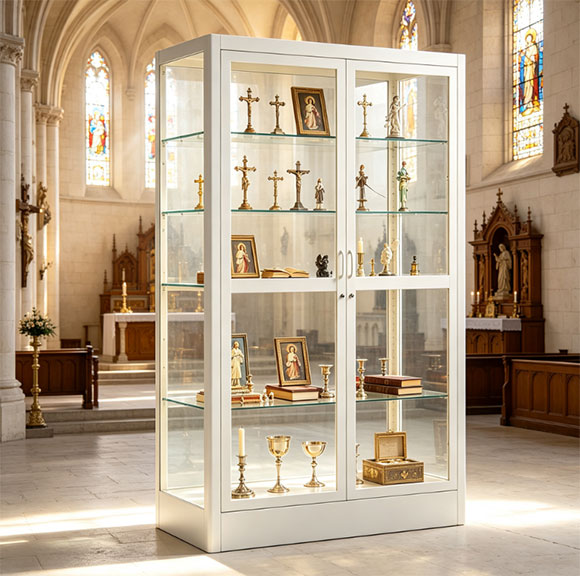
Most churches choose the 1800mm double-door in Classic White. The white frame blends into white or cream walls, and the objects inside the cabinet become the only thing you notice. For churches with darker interiors or stone walls, the Starlight Black frame works better—the glass seems to float without visible borders.
How Religious Institutions Pay for Display Cabinets
Churches do not have big equipment budgets. Most display cabinets in parishes are funded one of three ways:
A memorial gift. A family donates a cabinet in memory of a loved one. This is the most common path. We can add a small engraved brass plate to the cabinet frame: “In memory of [Name], from the [Family Name] family.”
A special collection. The parish takes up a designated offering. “For the months of March and April, our second collection will support the purchase of new display cabinets for the narthex.”
A capital campaign or building fund. If the church is already renovating or expanding, display cabinets can be written into the project scope as “liturgical furnishings.”
Because the factory cost is low, a single memorial gift can often cover two or three cabinets. The landed cost with sea freight makes it affordable even for parishes in developing countries.
What About LED Lighting Inside the Cabinet
Some artifacts benefit from internal lighting—a gold chalice, an illuminated manuscript, a silver processional cross. We offer warm white LED strips (3000K color temperature) that install inside the cabinet frame. The LEDs run on low-voltage USB power or a standard wall adapter. They add a small amount to the unit cost.
For churches that prefer a simpler look, the cabinet works perfectly without internal lighting. Clear tempered glass and ambient church lighting are enough for most displays.
How the Cabinets Ship
Glass cabinets need serious crating. We use reinforced plywood crates with closed-cell foam padding between every glass surface. Each crate is individually strapped and labeled. The cabinets ship in a flat-packed (KD) configuration, which reduces freight volume by about 40 percent compared to shipping fully assembled units.
Assembly is straightforward. Two people, a screwdriver, about thirty minutes per cabinet. The instructions are printed with diagrams, not just text, so language is not a barrier.
We have shipped church cabinets to West Africa, East Africa, Southeast Asia, and South America. The feedback we hear most often: “It arrived in perfect condition.” The crating is the reason.
If You Are Considering a Display Cabinet for Your Church
Send us a message. Tell us how many cabinets you need, what dimensions fit your space, and what you plan to display. We respond within two working days with a quote, production timeline, and photos of similar cabinets we have built for other religious institutions.
There is no minimum order. You can start with one cabinet, see it in your space, and order more when your community is ready. A sample order is the smartest way to begin.
The objects in your church have stories. They deserve a cabinet that tells those stories to the next generation, not one that hides them behind warped wood and cracked glass.
Request a quote for your church →
Also read: Why Steel Cabinets Outlast Wood in Tropical Climates | Protecting Fragile Objects from Dust and Moisture