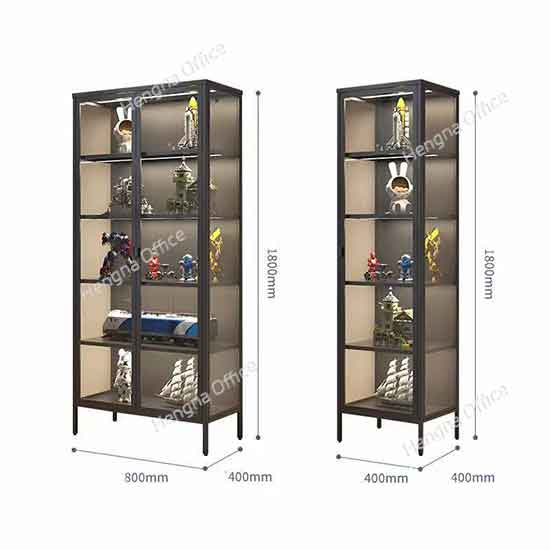
Gold Shop Display Cabinet UAE Supplier — Lockable Tempered Glass Jewelry Showcase for Dubai and Middle East Retailers | Secure Locking
The Gold Souk Standard
Walk through the Gold Souk in Dubai and you notice two things immediately. First, the sheer volume of gold on display—kilos of it, in every window, on every shelf. Second, every single piece sits behind glass. Not regular glass. Thick, tempered, locked glass.
That glass is not optional. A gold shop owner in the Gulf does not ask “should I get a display cabinet.” They ask “which cabinet gives my customers the clearest view while keeping the merchandise absolutely secure.”
If you run a jewelry store in Dubai, a gold shop in Riyadh, a watch boutique in Doha, or a luxury retail space anywhere in the Middle East, the display cabinet is the single most important piece of furniture in your store. It holds your inventory. It frames your brand. And it is the last physical barrier between a thief and your merchandise.
This guide covers what to look for in a gold shop display cabinet, why buying directly from a Chinese manufacturer makes financial sense for Middle Eastern retailers, and how to avoid the three most common mistakes jewelers make when ordering display cabinets from overseas.
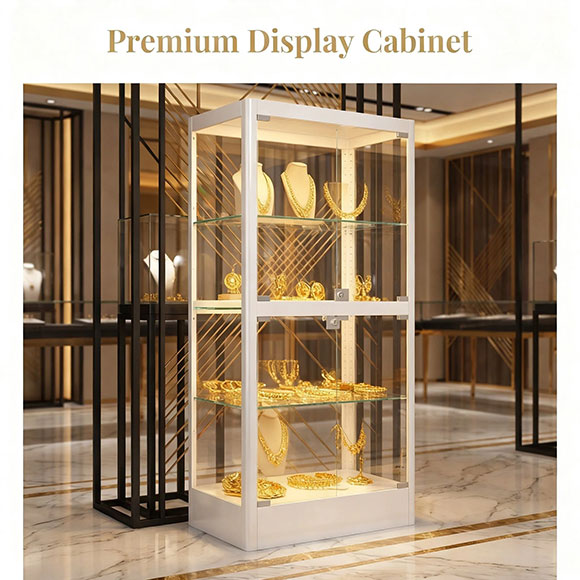
What a Gold Shop Display Cabinet Must Do
A jewelry display cabinet is not a regular showroom fixture. The requirements are specific, and getting one wrong can cost you a lot more than the price of the cabinet.
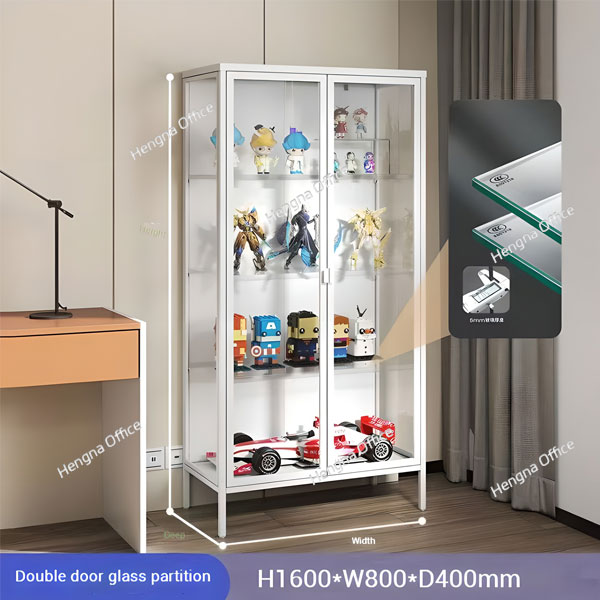
1. The glass must be genuinely tempered, and thick. Gold is heavy. So are luxury watches. A customer leans forward to look at a bracelet, presses both hands against the glass, and now the glass is supporting 60 kilograms of sudden pressure. 5mm tempered glass handles this without complaint. Regular 3mm glass does not. Ask any supplier: what is the exact thickness in millimeters, and what safety certification does the glass carry. Our cabinets use 5mm CCC-certified tempered glass—the same safety certification required for commercial storefront glass in China, which meets international standards.
2. The lock must be a real mechanical deadbolt. A jewelry cabinet with a magnetic push-to-open latch is a cabinet that someone can open with a firm pull. A proper key lock drives a steel deadbolt into the frame. You turn the key, the bolt engages, the door is part of the structure. You cannot pop it. You cannot slide a card between the door and the frame. Our metal key lock uses this deadbolt design on every cabinet.
3. The frame color matters more than you think. Gold looks different against different backgrounds. A white frame makes yellow gold pop but can make white gold look washed out. A black frame provides contrast that works for both, but in a brightly lit store it can feel heavy. Many Gulf jewelers choose a black frame for the exterior and white or cream interior backing. For shops that want a more luxurious look—common in the Dubai and Abu Dhabi markets—we offer custom gold-tone powder coating on the frame for orders of ten cabinets or more.
4. LED lighting is not optional—it is expected. A jewelry display cabinet without internal lighting is like a restaurant without plates. The gold needs to catch the light. Warm white LED strips (3000K color temperature) mounted inside the cabinet frame make yellow and rose gold glow. Cool white (4000K) works better for white gold, platinum, and diamonds. We offer both options, installed at the factory before shipping.
5. The cabinet must not look cheap. A gold shop’s entire atmosphere depends on looking prosperous. If the display cabinet has visible screw heads, uneven welds, or a rattling door, customers notice. They may not say anything, but they unconsciously downgrade the store in their mind. Our cabinets use concealed fasteners, clean welded joints, and smooth-operating hinges. The finish is electrostatic powder coating—not wet paint that chips after six months of daily opening and closing.
Why Gulf Jewelers Buy Cabinets from China
The logic is straightforward. A custom display cabinet from a local Dubai workshop costs a premium because the workshop is in Dubai. Labor, rent, materials—all priced for the Gulf market. A comparable cabinet from a European brand costs even more, plus air freight.
A factory in Luoyang, China, builds the same cabinet with the same materials—cold-rolled steel frame, 5mm tempered glass, key lock, LED lighting—at a factory cost that reflects the manufacturing economics of an industrial zone, not a Gulf retail district. The cabinet leaves our factory at a fraction of what a Dubai workshop charges. Sea freight from Shanghai to Jebel Ali takes about three weeks. Customs clearance adds a few days. Total landed cost per cabinet is still dramatically lower than buying locally.
This is not a secret. Gulf-based importers have been sourcing display fixtures from China for years. What has changed is that smaller shops—single-location jewelers, independent gold retailers, family-run businesses—can now do it directly, without going through a local import agent who adds their own margin.
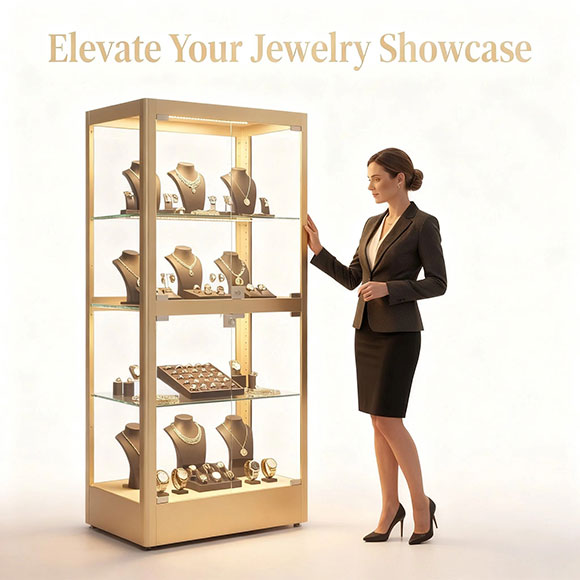
Which Cabinet for Your Store
| Store Type | Cabinet | Why |
|---|---|---|
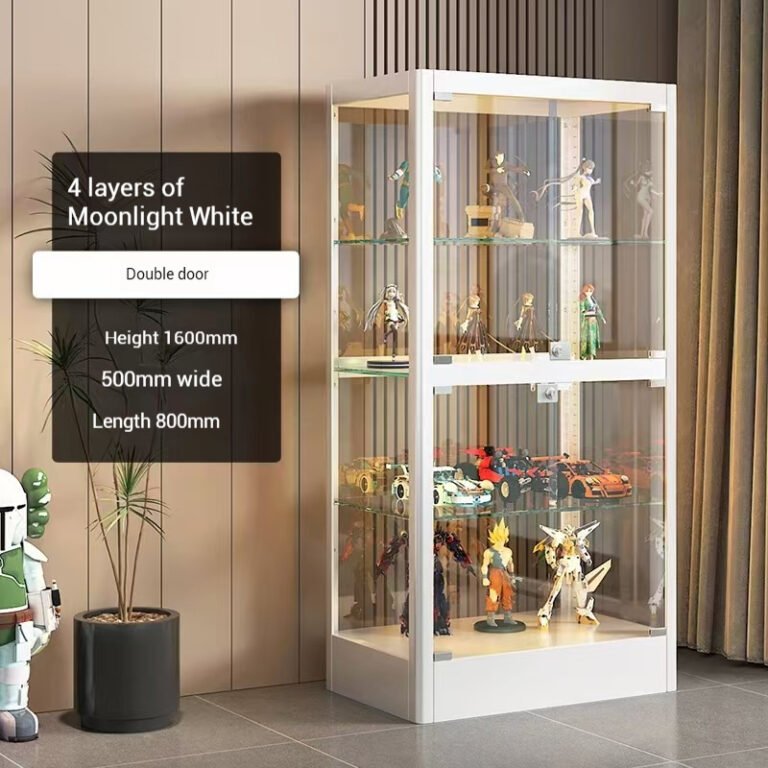
| Small gold shop, single display wall | 1600mm Double Door, 4 shelves | Fits compact retail spaces, holds 30-50 pieces |
| Medium jewelry store, main display area | 1800mm Double Door, 5 shelves | The standard choice—tall enough to command attention, wide enough for trays |
| Large showroom, luxury watch section | 2000mm Double Door, 5 shelves | Maximum presence, ideal for watches that need vertical display space |
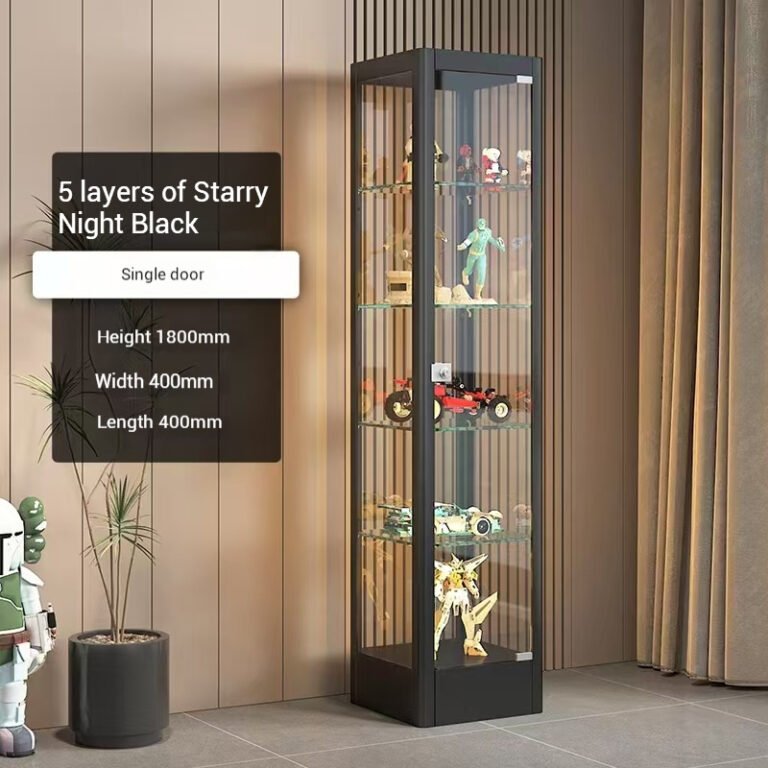
| Counter-top display for small items | 400mm Single Door, 5 shelves | Rings, earrings, small pieces at eye level |
| Center-of-store island display | Full-transparent 4-side model | Customers walk around, see merchandise from all angles |
Most jewelry stores combine sizes: two or three 1800mm double-door units along the main wall, a full-transparent island in the center of the shop, and a 400mm single-door unit on the counter for the most expensive pieces. This layout gives a full-spectrum browsing experience without wasting floor space.
Three Mistakes Jewelers Make When Ordering From Overseas
Mistake 1: Not asking for production photos of actual cabinets. A catalog photo means nothing. Ask for photos of cabinets currently on the factory floor, not renderings, not studio shots from three years ago. If a factory cannot send you a phone photo of a cabinet they are building right now, they are not building cabinets.
Mistake 2: Ordering too many without testing one first. Start with a sample. One cabinet. Ship it. Unpack it. Put it in your store. Let your staff use it for a week. Watch how customers interact with it. Check if the door closes smoothly, if the LED strip gives even light, if the lock feels solid. Then order the rest. We ship single-unit samples to any country. The freight cost on one cabinet is higher per unit than a container load, but the risk is zero compared to ordering twenty cabinets you have never seen in person.
Mistake 3: Not confirming the glass thickness and certification in writing. “Tempered glass” means nothing unless the thickness and certification are specified. Get it in the order: “5mm tempered glass, CCC certified, with certification document included in shipment.” This protects you if something goes wrong and protects your insurance claim if a cabinet arrives with damaged glass.
Shipping to the Gulf: What to Expect
Sea freight from Shanghai to Jebel Ali (Dubai) takes approximately three weeks. To Dammam (Saudi Arabia) or Hamad (Qatar), add a few days for the Gulf feeder service. Customs clearance in the UAE is efficient for commercial imports—typically two to four business days with a proper commercial invoice and packing list.
Each cabinet ships in a reinforced plywood crate with foam padding. The cabinets are flat-packed (KD structure), which means the glass panels, frame components, shelves, and hardware are packed separately in custom-cut foam slots inside the crate. Assembly takes about thirty minutes per cabinet with two people and a screwdriver. Instructions are diagram-based, not text-based, so language is not a barrier.
We have shipped to jewelry stores in Dubai, Abu Dhabi, Sharjah, Riyadh, Jeddah, Doha, and Kuwait City. The feedback is consistent: the cabinets arrive intact because the crating is done right.
What This Means for Your Store
A gold shop without proper display cabinets is leaving money on the counter. The merchandise looks less valuable. Customers trust the store less. The shopping experience feels temporary, like a market stall rather than a professional jewelry retailer.
The investment in good display cabinets pays for itself in higher perceived value. When a customer sees a gold bracelet inside a properly lit, locked, tempered glass cabinet with a clean black steel frame, they perceive that bracelet as more valuable than the same bracelet sitting on an open velvet tray. This is not theory. It is retail psychology that every successful jeweler uses every day.
If you are setting up a new jewelry store, renovating an existing shop, or expanding to a second location in the Gulf region, contact us for a quote. Include the dimensions of your space, the number of cabinets you are considering, and whether you need LED lighting and custom frame colors.
Request a quote for your jewelry store →
Also read: Why Steel Display Cabinet Frames Beat Wood and Plastic in Retail | Tempered Glass in Retail Settings: How Much Force Can It Take