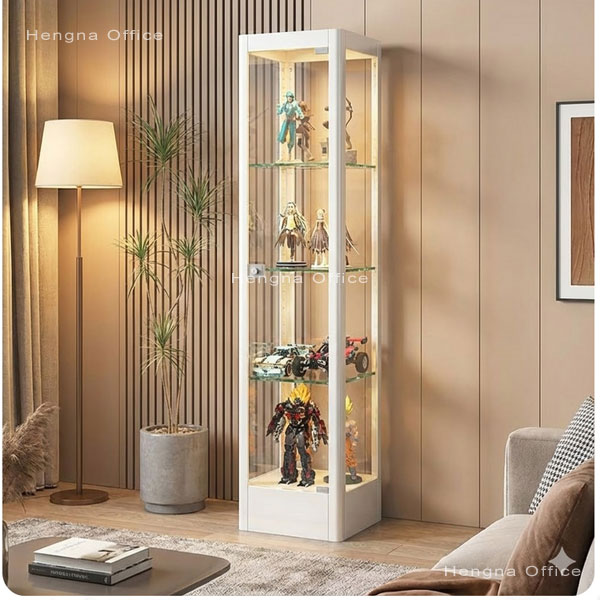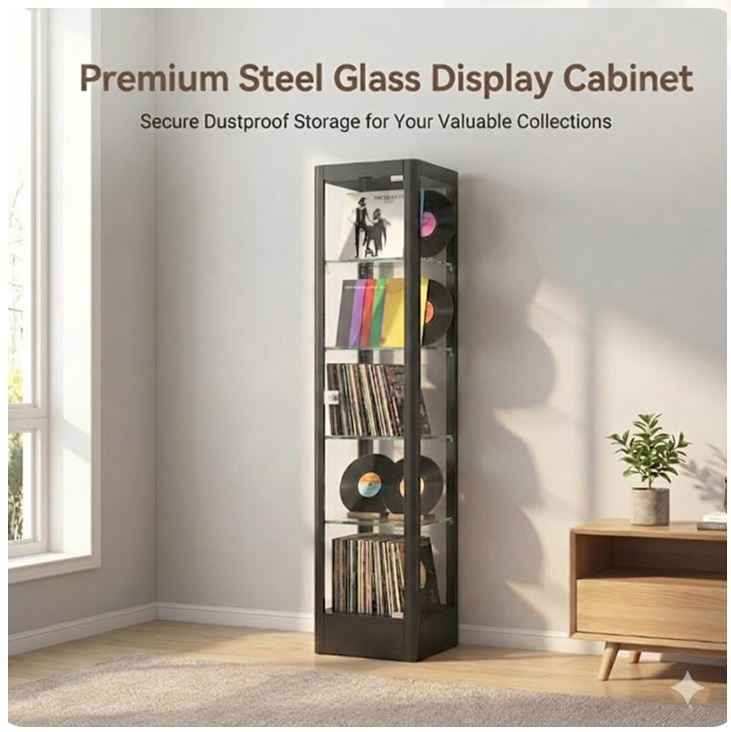
Dustproof Specimen Display Cabinet Sealed Steel Frame White — Because Extinction Shouldn’t Happen Twice
How This Cabinet Started
A university biology lab reached out to us last year. They’d stored a butterfly collection in wooden cabinets for six years. When they opened them up, half were eaten by pests. The other half had moisture damage — wing patterns blurred, useless for research. The professor who’d collected those specimens as a young researcher was gutted.
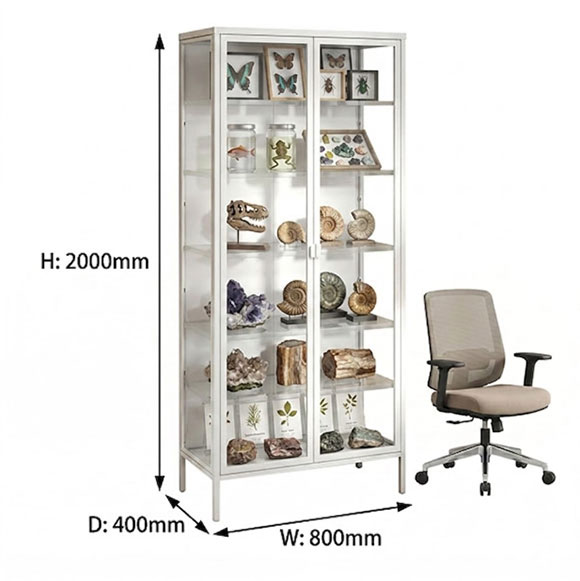
They asked if we could adapt our pathology cabinet design into a sealed display unit for specimens. We gave it a shot. Cold-rolled steel frame, sealing strips around the doors, tempered glass front, white powder coat — clean, bright, exactly what a lab should look like. Installed it, measured humidity inside versus outside for a month. The cabinet interior was nearly half as humid as the room.
The professor looked at the data and said, “Should have come to you years ago.”
Word traveled. Neighboring university heard about it. Then a natural history museum. Now at every trade show, someone stops by and asks, “You still make those sealed specimen cabinets?” Yes. We do.
This is not a regular display cabinet. It’s for the stuff you can’t replace. Specimens. Fossils. Minerals. Historical artifacts. Things where “ruined” means gone forever.
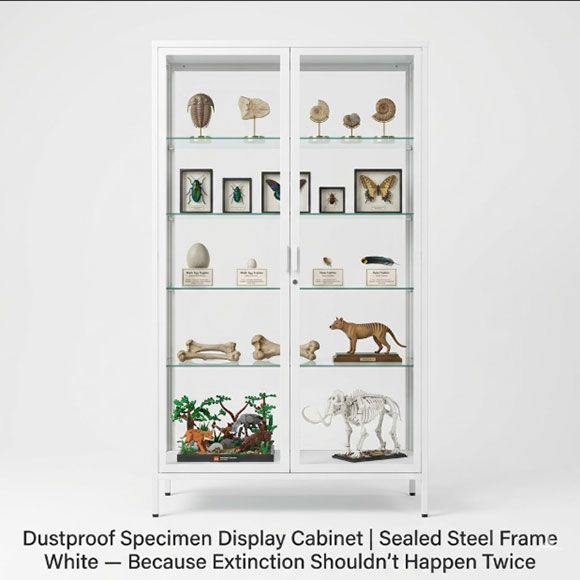
Dustproof Specimen Display Cabinet Sealed Steel Frame White Specs
| Item | Detail |
|---|---|
| Overall Dimensions | H1520 × W515 × D480mm (4-stack) / Single unit H360mm |
| Frame Material | Cold-rolled steel, electrostatic powder coated |
| Door | 5mm tempered glass, double-door |
| Sealing | Full-perimeter sealing strips on door edges |
| Shelf Capacity | 30kg per shelf |
| Shelves | 4 adjustable |
| Color | White (standard), Grey available |
| Base | Stainless steel, raised off the floor |
| Capacity | Fits standard pathology slides (horizontal) or specimen boxes (vertical) |
| Packing | Foam corners + stretch film + full wooden crate |
| Assembly | Fully assembled — unwrap and use |
| Lead Time | 15-20 working days |
| OEM | Logo silkscreen, label holder customization, drawer divider customization |
Why Sealing Matters
Anyone who’s worked with specimens knows the three killers: dust, moisture, pests. One of them gets in, your specimen is done.
Wooden cabinets absorb moisture. Humid summer, the wood swells. Dry winter, it shrinks. Swell, shrink, swell, shrink — the seals loosen. Once there’s a gap, pests crawl in. By the time you notice, the specimen is riddled with boreholes.
We don’t use wood. Cold-rolled steel doesn’t swell. Doesn’t shrink. Doesn’t absorb anything. The sealing strips sit tight in a steel door frame. When the doors close, the gap is compressed to a minimum. Humidity inside stays steadier than any wood cabinet can manage. Bugs can’t get in. Dust can’t settle.
Not claiming this is a climate-controlled museum case. But with the sealed steel frame combination, you get closer to museum-grade preservation conditions in a regular room than you’d expect.
Sealed Steel vs Traditional Wood:
| Ours (Sealed Steel) | Traditional Wood | |
|---|---|---|
| Seal Integrity | Rubber stripping, gap ≤1mm | Wood frame warps, gap widens yearly |
| Moisture Resistance | Steel doesn’t absorb, base raised | Wood absorbs, humidity spikes in wet season |
| Pest Protection | Pests can’t enter | Wood frame + gaps = pest habitat |
| Dust Protection | Near dust-free interior when sealed | Dust enters through gaps, settles in months |
| Fire | Non-combustible | Combustible — lab hazard |
| Lifespan | 10+ years | 3-5 years before deformation |
| Formaldehyde | Zero | Particle board off-gasses formaldehyde |
| Best For | Specimens, fossils, artifacts, minerals | Models, props, things you can re-order |
The difference: specimen damage is permanent.
Where Dustproof Specimen Display Cabinet Sealed Steel Frame White Fits
University Biology Labs. Teaching specimens. Research specimens. Butterflies, insects, pressed plants, skeletal samples. Students access them daily. Doors open and close constantly. If the seals can’t handle the frequency, the inside gets dusty within weeks. White cabinet matches the clean, bright look of a modern lab — no dark corners, everything visible.
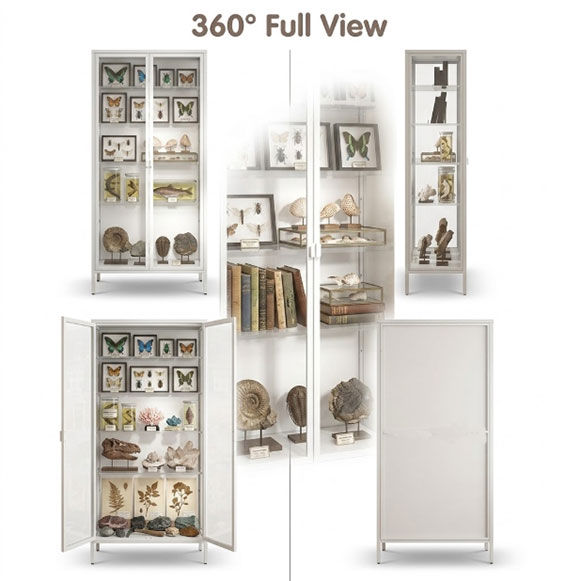
Natural History Museums. Museum display means visitors press their faces against the glass. Glass can’t wobble. Cabinet can’t shake. Seals can’t loosen. Our tempered glass doors on metal hinges open and close smoothly, no vibration, no glass shake. White finish keeps the focus on the specimens, not the furniture. Visitors don’t see the cabinet. They see the specimen. That’s the point.
Pharmaceutical Showrooms. Herb specimens, raw material displays, pharma history exhibits. Medical showrooms need “visible and traceable” — specimens must be clearly seen while staying preserved. Sealed + glass door is built for exactly that. White is the standard in medical and pharmaceutical settings — it signals clean, professional, compliant.
Private Collectors. Insect collections. Shell collections. Fossil collections. Mineral crystals. What you’ve invested isn’t just money — it’s your time. A beetle specimen might have taken three years from larva to adult. Lose it at any stage and those years are gone. White cabinet makes the colors of your collection pop — a butterfly’s iridescent wings against a clean white backdrop, no visual noise.
Modular System
The cabinet stacks in four levels. Each level is 360mm tall. Stack four, you’ve got 1520mm. Use one standalone on a desk for small collections. Stack all four against a wall for a proper specimen room setup.
Standard pathology slides fit horizontally. Specimen boxes stand vertically without tipping. Label holders come standard on every drawer — write the scientific name, collection date, collector. Open the drawer, you know exactly what’s inside before you even look.
If your space has different requirements, dimensions can change. Some museums need deeper. Some labs need wider. The steel frame foundation stays the same. Length, width, depth — all adjustable.
Shipping
This cabinet ships fully assembled. Not because we can’t do knock-down. But sealing strips, when installed at the factory with proper fixtures, sit perfectly tight. Install them on-site with a screwdriver, and the seal won’t be the same. So we build it, seal it, test it at the factory, then crate it.
Yes, assembled shipping takes more space. Yes, freight costs more. But think about what this cabinet is holding. The specimens inside are worth more than the freight difference.
Packing: eight foam corner protectors, three layers of stretch wrap, full wooden crate. We’ve shipped to the US, Germany, Japan. Breakage rate under 2%. If the glass breaks in transit, free replacement.
Customization
Sizes adjustable. Deeper for large specimen boxes. Taller for vertical display stands. Large orders, no mold fee. Small batch, a bit extra.
Color. White is standard — clean, modern, and the default in labs and museums worldwide. Grey is available if you prefer a darker look.
Drawer dividers can be customized. Some clients need slots for glass slides. Others want compartments for mineral specimens. Send your requirements, we build to match.
Silkscreened logo. Custom label holders. Custom drawer fronts. All standard OEM. No extra charge.
FAQ
How do you verify the seal? Every cabinet goes through a seal check before shipping. We inspect each unit at the factory and the sealing strips are fitted with precision tooling, not hand-applied. You’ll see the difference the first time you close the doors.
How long do the sealing strips last? 5-8 years under normal use. When they eventually need replacing, we ship replacement strips. Five minutes with a screwdriver, you’re done.
MOQ? Standard model: 5 units. Custom size/color: 10 units. Sample: 1 unit.
Warranty? 1 year.
Shipping cost? Depends on the port. Assembled: roughly 30-40 units in a 20ft container, 60-80 in a 40ft. Send your destination port, we’ll quote.
Worth importing from China vs buying locally? Depends what you’re protecting. Student craft projects? Local wood cabinet is fine. Research specimens? Museum collections? Private collections you’ve spent years building? You don’t gamble on wood absorbing moisture. The extra cost is insurance for your specimens.