
Tempered Glass Display Cabinet — Is It Strong Enough for Everyday Use in a Home with Kids
You want a display cabinet for the living room or hallway. White or cream white, glass door, tall and narrow.
And you have kids. So the first question that pops into your head isn’t “how much will this hold.” It’s “what happens if that glass door breaks.” A kid running into it. A toy flying into it. A fall near the cabinet with a hand going through the glass. You’ve thought about it.
This isn’t a problem unique to display cabinets. Any piece of furniture with glass triggers the same question when there are small children in the house. But tempered glass and regular glass are not the same material. They share a name. They don’t share a safety profile.
Tempered Glass Display Cabinet|How strong is tempered glass really
Tempered glass starts as regular glass and goes through a heating and rapid cooling process — heated to over 600 degrees, then blast-cooled. This changes the internal stress structure. The surface is compressed, the interior is tensioned. The result is a material several times stronger than regular glass of the same thickness.
This difference is not a marketing claim. It’s defined in ASTM C1048, the industry standard for heat-treated glass. A 5mm tempered glass panel has significantly higher flexural strength and impact resistance than the same thickness of annealed (regular) glass.
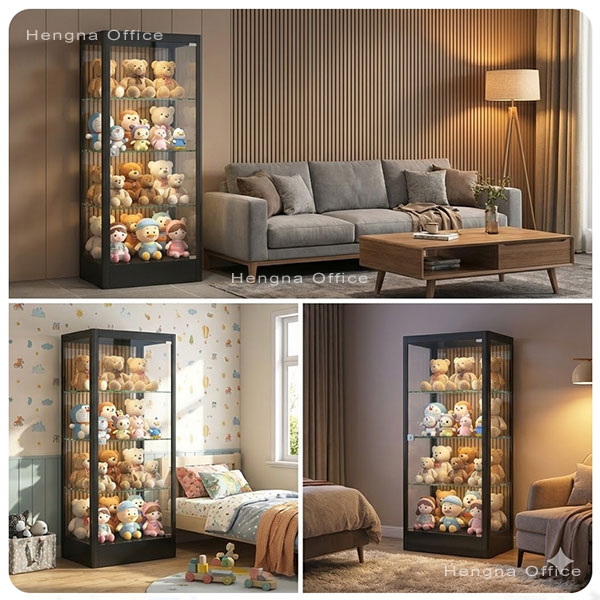
In everyday use, the force a child generates by running into a cabinet or throwing a toy at it is well below the threshold that tempered glass can handle. The glass door on most display cabinets is 5mm thick. Thicker than most home windows. Slightly thinner than a shower door. But its impact resistance exceeds both because of the tempering process.
What actually happens when tempered glass breaks
Regular glass breaks into sharp shards. Large, jagged pieces with cutting edges. That’s the dangerous kind.
Tempered glass breaks into small granules. Like coarse salt or tiny pebbles. No sharp edges. Not because it’s “designed to break safely” as a feature — because the internal stress structure physically cannot form sharp shards when it fractures. The same principle applies to car side windows and phone screen protectors.
So if a display cabinet ever breaks under extreme impact — a heavy object thrown at it, the cabinet tipping over, a severe drop during a move — the glass turns into a pile of blunt granules. It might scratch. It won’t slice.
Everyday impact scenarios in a home with kids
Think through the real scenarios:
A child runs a toy car into the cabinet door. Tempered glass handles this easily. The weight and speed of a toy car generate impact forces far below what the glass is rated for.
A child trips near the cabinet and hits the door with a shoulder or hand. If the impact is hard enough, the child gets a bruise — the same bruise they’d get from hitting a wall, a wood cabinet, or a solid door frame. The glass itself won’t crack.
Something larger hits the glass — a thrown remote, a book, a toy at higher speed. Depends on the speed and the point of impact. Usually nothing happens. If it hits the edge or corner of the glass panel at high enough speed, it might develop a crack. But unlike regular glass, tempered glass with a crack doesn’t immediately collapse. It holds together as one piece, then breaks into granules over the next few minutes to hours.
How display cabinets actually get used in a home
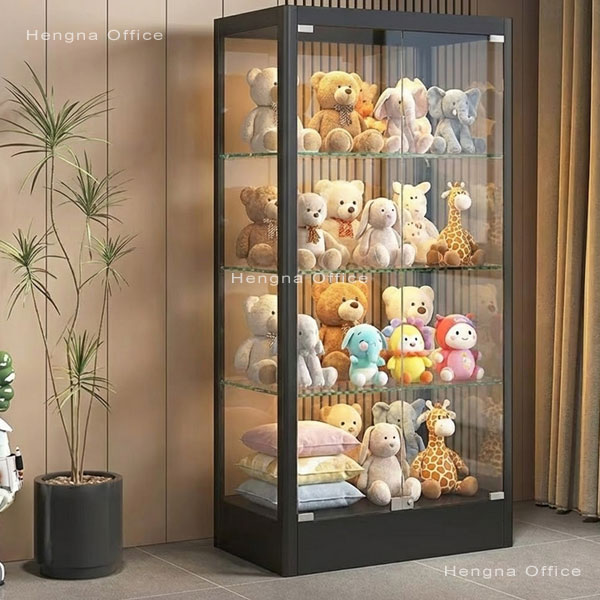
A display cabinet is not a high-traffic piece of furniture. Unlike kitchen cabinets or closet doors that open dozens of times a day, a display cabinet door opens a few times a week. The rest of the time it stays closed, doing what it’s meant to do — showing what’s inside.
Display cabinets also tend to sit against walls or in corners, not in the middle of traffic paths. The probability of a child running into one is lower than running into a coffee table or a TV stand, both of which are lower to the ground and harder to see.
The glass on a display cabinet also sits higher than a window. On a 78-inch tall cabinet, the glass door starts well above a young child’s center of gravity. A toddler can’t easily reach the glass panel at all.
So the real question isn’t “will the glass door break.” It’s “is the cabinet stable.”
What to look for when buying a tempered glass display cabinet
First, confirm it’s actually tempered glass. Legitimate products are marked — a 3C certification stamp, a “Tempered Glass” label, or a manufacturer specification sheet. If there’s no marking, don’t assume.
Second, check the edge frame. The glass panel should be fully enclosed in a metal or plastic frame with no exposed edges. Tempered glass is strongest at its face and weakest at its edges and corners. A good frame protects the vulnerable parts.
Third, look at the hinges. Glass doors are heavier than wood doors. Cheap hinges will sag over time. Stainless steel hinges with soft-close dampers are the right spec.
Fourth, make sure the cabinet sits level on the floor. Adjustable leveling feet are standard on quality cabinets. If the cabinet rocks or wobbles, nothing else matters.
How it compares to other materials
Solid wood cabinets have no glass safety concerns, but they come with their own issues — formaldehyde in some finishes, warping in humid conditions, and weight that makes them hard to move.
Acrylic display cabinets are lightweight and won’t shatter, but they yellow over time and scratch visibly. Within a year or two they look tired.
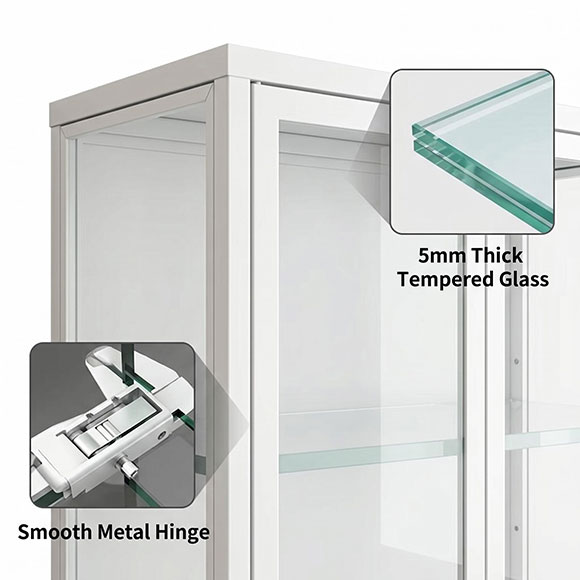
Tempered glass sits in a practical middle ground. Stronger than most people assume, safer than regular glass by a wide margin, and easy to maintain with a quick wipe. If you accept the premise that extreme impact can break it but the breakage won’t be dangerous, it’s the safest glass option for household furniture.
Summary
Tempered glass display cabinets are safe enough for homes with kids. Not because any product is unbreakable — but because tempered glass is considerably stronger than people give it credit for, and its failure mode doesn’t produce the kind of sharp fragments that cause serious injury.
The thing to focus on isn’t the glass door. It’s whether the cabinet is stable and well-built. In practice, more household cabinet accidents come from tip-overs than from glass breakage.
So the first question isn’t “is this glass strong enough.” It’s “will this cabinet stay put in my home.” If the answer is yes, the glass door is the least of your concerns.
(If you’re looking for a tempered glass display cabinet with a lock for extra peace of mind, check out our cream white lockable model — designed with families in mind.)
